The masticatory function
During his PhD years, Andrea Merlo, MBE’s founder, participated in several research projects on the study and analysis of chewing.
Chewing is a vital human function, made possible by a balance between the different structures involved, such as the maxillary and mandibular arches, the temporomandibular joint and the mouth muscles.
Ad hoc software for dental devices
Working with Dr. Maria Grazia Piancino and Prof. Pietro Bracco, we measured jaw kinematics and dynamic EMG to study the muscle groups involved in the masticatory function, designing a stand-alone software for the computer analysis of the chewing cycle and developing the respective meaningful indices.
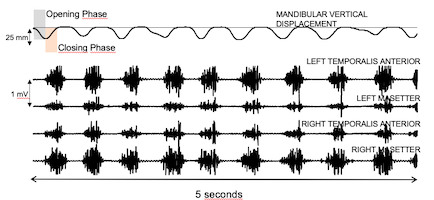
For example, we created a software to boost the Myotronics K7, a device capable of measuring the kinematics of masticatory and mandibular function, without limiting the patients’ range of motion or affecting their sensitivity.
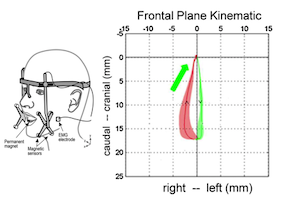
Thanks to the enhancement achieved years ago, this tool is still widely used to analyse masticatory function by the prevalence of reverse chewing cycles, which is used as a biomarker of chewing impairment, in bilateral and unilateral crossbites. As this condition has to be corrected especially in children, because it can lead to an altered growth of the jaw, the previous cited devices combined with the MBE software are employed to assess the differences between before and after the use of dental corrections.
Publication activity
MBE’s collaboration with Professor Piancino lasted about a decade, during which time we supported odontostomastology practice through the required bioengineering skills, including data analysis for several clinical studies conducted and the design of appropriate software.
Several papers authored by MBE have been published in leading dental journals. Let’s have a look the the stunning book Understanding Masticatory Function by Prof. Maria Grazia Piancino!