Stroke is one of the main neurological acquired diseases, and upper limb impairment is one of its most common sequelae. In clinical practice, it is usually assessed by clinical rating scales.
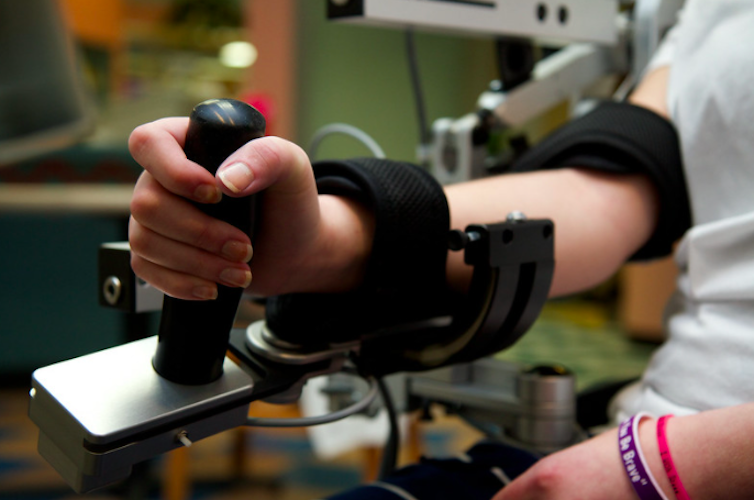
In recent years, the use of robotic devices in rehabilitation has increased, especially in neurologic patients, thanks to the several potentialities they offer, such as the gravitational support of the limb that allows assisted movements even in the days immediately after the acute event. Moreover, robots can compute motion indices very useful for upper limb assessment.
Our first study: direction-specific indices of reaching ability in stroke patients
In 2014 the first study was conducted by the rehabilitation team of the Sol et Salus Hospital in Rimini, inclusive of PTs, OTs and PMR doctors.
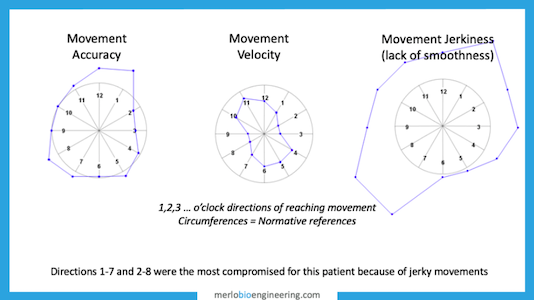
We designed and developed a software to boost the motion analysis ability of the Armeo®Spring device by Hocoma, calculating indices of accuracy, velocity and smoothness. These three parameters were calculated independently for the different directions of the upper limb during the reaching task.
This would have given the therapist a precise idea of the direction of movement on which to concentrate the rehabilitation, because they were still lacking.
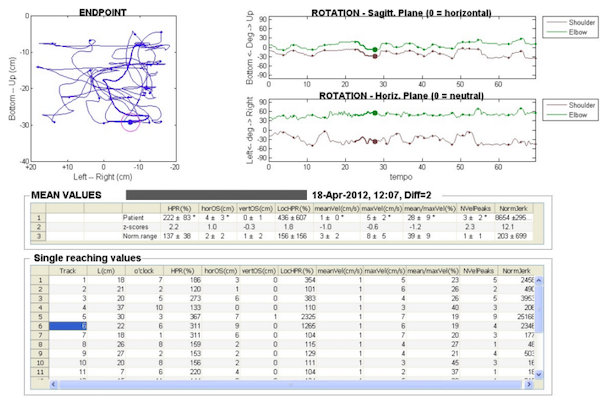
A sample of healthy subjects performed a specific task of the Armeo®Spring, involving reaching a ladybird on the screen at four levels of difficulty, thus allowing the extraction of nine indices representing the evolution of the motion. From these values we calculated the normative data, which allowed us to compare healthy subjects’ indices with those of neurological patients, in a second study.
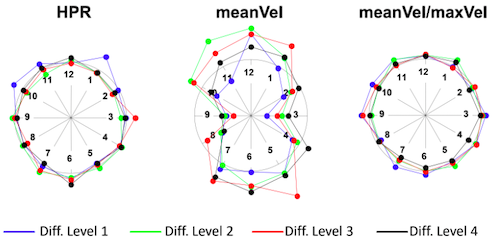
Validation of new motion indices
The normative values provided were then used in a new validation study in 2016 and compared with data from 44 post-stroke patients in the sub-acute phase, who had already been assessed the Wolf Motor Function Test.
The results showed a significant difference between healthy individuals and patients, detected by the indices. In particular, at least one of the indices for each category had discriminatory ability of the pathological condition and showed a correlation with WMFT scores, confirming the ability of instrumental assessment to evaluate dynamic functional tasks, reproducible in the activities of daily living.
Thanks to a Principal Component Analysis, the most effective parameters to represent the three groups were then identified: the global Hand Path Ratio for accuracy, the Mean Velocity for velocity and Number of local Peaks in the Velocity profile for fluency. These indices are capable of assessing the functionality of the upper limb of sub-acute neurological patients, integrating the clinical scales.
The use of robotic devices in rehabilitation and bioengineering fields will show more and more developments in the future, thanks to their capabilities in allowing early assisted movement in different planes of space, while monitoring progress in real time thanks to the data collection provided at every employment.
Indeed, the greatest success has been the integration of the movement analysis of the upper limb with this new method in the daily work of the OTs, who developed a specific rehabilitation protocol together with the PMR doctors of the hospital, based on the several observed problems.
Another study was conducted with the colleagues at the Scientific Institute IRCCS Eugenio Medea, Bosisio Parini, Lecco, Italy on the use of Armeo®Spring with our customised software to assess upper limb functionality in children with neurological pathologies (link).