
Patello-Femoral Pain Syndrome (PFPS) is a frequent syndrome in young active individuals, affecting 15-45% of the population. This syndrome is clinically relevant since it limits daily activities and sports practice in adolescents.
Its manifestation involves diffuse pain originating from the anterior aspect of the knee, most commonly along the medial aspect of the patella. Pain is exacerbated by activities like going up and down stairs, squatting, sitting for a long period with knees bent over 90°, and kneeling.
Patello-Femoral Pain Syndrome is caused by a combination of several risk factors. Among these causes, delayed muscular activation of vastus medialis has been long considered the main factor, although with inconsistent results.
Onset detection of vastus medialis
From a brief literature review, we highlighted some methodological weakness among published studies affirming the leading role of the delayed vastus medialis activity in the manifestation of the PFPS. In particular, the EMG data detection and analysis methods used had rather large margins of error, and the magnitude of the results often fell within these ranges, although the authors did not make this explicit.
From these considerations, we conducted a trial in which we analyzed patients with Patello-Femoral Pain Syndrome compared to healthy subjects while performing different tasks. Surface EMG of vastus medialis and vastus lateralis was recorded.
Tasks included: sit to stand, stand to sit, squat, step up and step down. The delay in seconds between the onset of vastus medialis and vastus lateralis was computed (ΔT_Onset), as well as the delays in seconds between the time instants at which the normalized envelopes reached the 5%, 10%, 20% and the peak value of the reference contraction (respectively, ΔT_5%, ΔT_10%, ΔT_20%, ΔT_Peak).
The error in the onset estimate of the double-threshold method was 0 ± 21 ms.
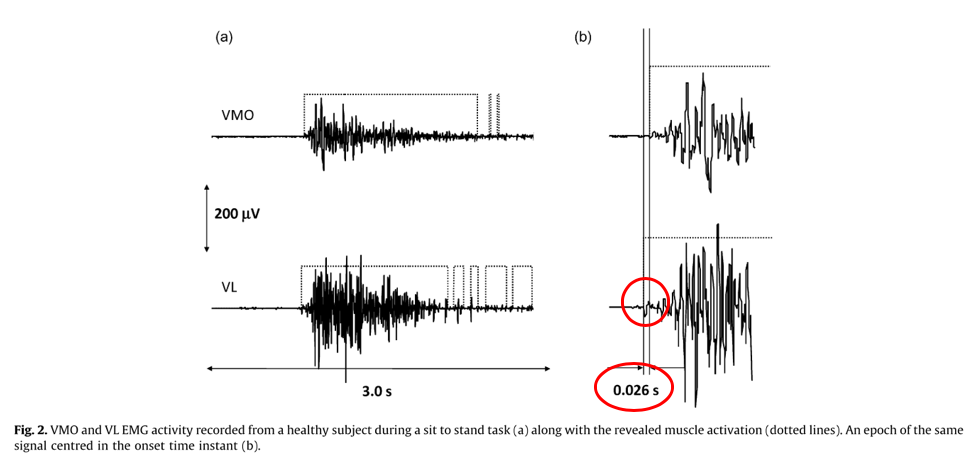
Reprinted with permission from Cavazzuti et al. 2010
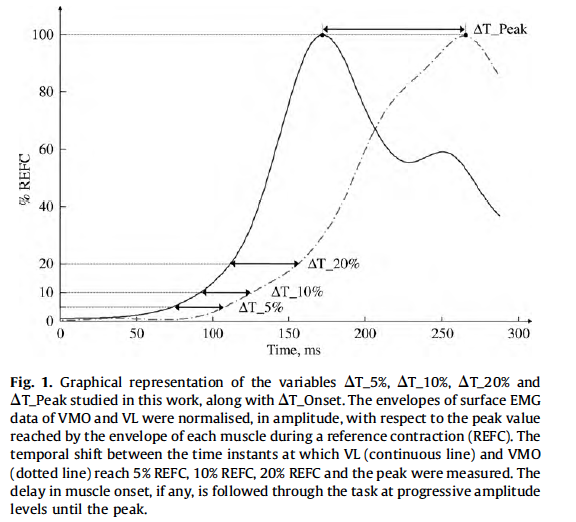
Reprinted with permission from Cavazzuti et al. 2010
Evidences do not support that Vastus medialis is responsible for patello-femoral pain syndrome
In our study, vastus medialis did not activated after vastus lateralis in any of the investigated tasks, both in patients and controls. The minimal differences observed are on the order of milliseconds, so this cannot be blamed for the onset of patellar pain. These findings do not support the hypothesis that vastus medialis delayed onset is responsible for Patello-Femoral Pain Syndrome.
Attention to methodology
When dealing with EMG data, special care must be taken, and the equipment used must be well known by researchers. The risk is to produce literature with apparently favorable results, that instead fall within the range of measurement error. Since research guides clinics, researchers have the duty to pay attention when publishing new materials.
However, clinicians cannot be expected to know all the technical features of the bioengineering tools made available.
MerloBioEngineering can support you in the method-development phase, selecting together the best outcome measures based on the instrumentation at your disposal. This way you will be sure to handle reliable data that will lead you to strong, evidence-supported conclusions.
If you need a consultation, you can contact us at the appropriate section of the site.