Understanding structural changes in neurologic patients
Soft tissues (yes, you heard me right: we’re not just talking about muscles!) of neurological patients can suffer from various alterations of central and peripheral origin, of which the best known and most cited is spasticity.
However, there are many more phenomena that can occur and need to be distinguished. Cocontraction, for example, shows itself as a pathological simultaneous contraction of a pair of agonist-antagonist muscles. Stiffness, on the other hand, is a reduction of passive muscle extensibility, characterised by peripheral changes to the muscle.
The combination of these conditions can lead to deformities such as the equino-valgus, even in children with Cerebral Palsy who are still very young, limiting their walking and thus their development of autonomies.
Our study on little hemiplegics
We conducted a study in collaboration with the Timone Children’s Hospital in Marseille to investigate the mechanisms underlying limited foot dorsiflexion during the swing phase and the equino-valgus deformity at initial contact in hemiplegic children.
We aimed to quantify the passive extensibility and the spasticity of the triceps surae and to measure the spastic cocontraction of the gastrocnemius medialis and peroneus longus, during the swing phase.
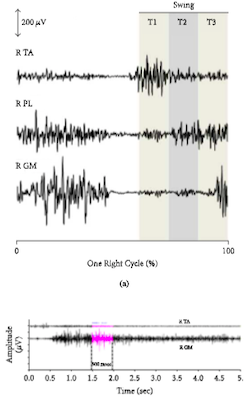
Ten children between the ages of 2 and 5 were analysed by means of gait analysis and dynamic EMG, dividing the swing into three sub-phases of equal duration (T1, T2, T3).
Cocontraction and stiffness combined together
A reduction in triceps extensibility has been noted by age 5: the difference between tension threshold and maximal stretch course was similar for both sides, but the plegic side seemed to be shifted towards the plantar flexion position.
Moreover, there was a significant difference for the cocontraction index between the paretic and the nonparetic limb for both muscles investigated. In particular, the gastrocnemius medialis was active from the second subphase (T2), while the peroneus longus remained active throughout the whole swing, despite normative data indicating that it should have always remained at rest.
Can you guess the causes? They are all clarified in the open access full article here.
Understanding the mechanisms underlying these central and peripheral alterations will allow us to improve therapeutic interventions and the path development of these little patients.