The PhD project at the University of Turin
Mastication involves complex and synchronous movements of the jaws, tongue, and cheeks to correctly position the bolus between the grinding surface of the teeth. Phenomena of malocclusion during developmental age can lead to the establishment of structured pathological conditions, such as altered mandibular growth. The PhD research by Andrea Merlo, MerloBioEngineering founder, was carried out in 2008-2011 at the Dental School of the University of Turin, which was directed by Professor Pietro Bracco, and focused on the instrumental evaluation of chewing, to validate a new method of dynamic analysis of masticatory cycles, through appropriate statistic and data analysis, under the guidance of Dr. Maria Grazia Piancino.
Current literature and criticality
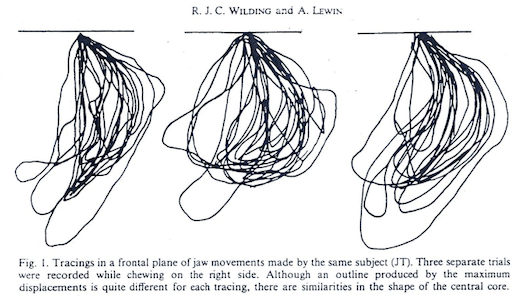
The main issue challenging the production of scientific material about this subject was the difficult management of highly variable data, due to the non-purely cyclicity of the movement and to intrinsic factors relating to the characteristics of the bolus.
The protocols proposed by Buschang, Lewin, and Shiga already present in the literature were suitable for the assessment of healthy subjects but failed with patients with occlusion problems, because they tended to eliminate the variability of several cycles, through the calculation of the mean value. Intra-subject variability must always be considered a source of useful information – especially in patients’ assessment – which must not be lost in favour of generalisation.
A custom-made software to maintain variability: the MSC method
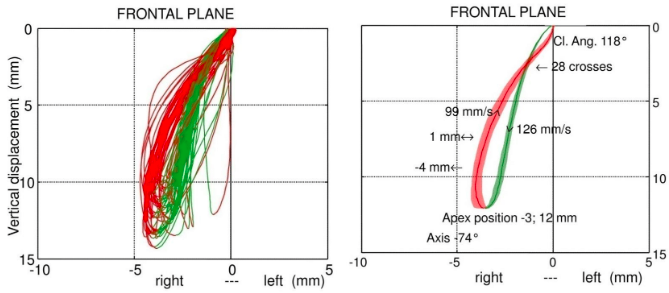
A novel algorithm, using a median operator on a sorted collection of cycles, was used to obtain the average profile without any resampling of the data, specifically designed to be robust for outliers and therefore suitable with patients. The produced graphs no longer represented the mean value but included the median cycle together with the 25th and 75th percentile confidence bands, to better show the variability.
A set of custom-made software tools were designed in order to analyse the chewing cycle parameters by semi-automatically dividing data into consecutive cycles: the estimation of local maxima and the exclusion of movements not properly part of the masticatory cycle were key elements of the new instrument. Finally, a set of rules with a robust-regression approach was chosen to determine the closing angle, a fundamental indicator of malocclusion.
The repeatability study: application in the clinical practice
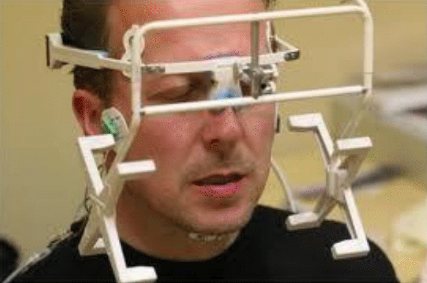
At the end of the PhD work, a repeatability study on the new analysis method was conducted on 20 healthy subjects to determine the Smallest Real Difference, a measure able to establish the necessary amount of change in the indices to infer a significant clinical change in patients after a correction treatment, i.e. to differentiate a physiological variability from a real index of change. The chewing cycles with soft and hard bolus were recorded by the Myotronics K7 kinesiograph with the protocol used in the Dental School of Turin and analysed by Merlo’s algorithms. The test-retest repeatability calculated with the ICC index was good for all the parameters taken into analysis and made it possible to propose the MSC method within the clinical evaluation of the subjects, also providing reference normality values.
The custom-made software developed during the PhD research was used in several studies conducted in the following years, which will be discussed in more detail in future editorials.
Research made easy
The MBE software allows each patient to be analysed in detail, obtaining all the curves, numerical indicators and a report in Word format that is compiled automatically, facilitating the clinician’s work.
A button with the function “analyse folder” allows automatic analysis of the data of all the subjects in the sample, obtaining for each one a set of quality control images of the analysis and a CVS file with all the numerical results, ready for statistical analysis.
This is the kind of solution MBE offers its customers.
Have a look at the “Research and Consulting” section to see the several studies conducted with our software and do not hesitate to contact us for more information.