Standard markers placement effort and new IMU systems
We present the validation process of a new IMUs-based motion analysis system managed by Ing. Merlo.
In the clinical practice of Motion Analysis Laboratories, several markers are placed on patients’ landmarks in order to obtain their joint kinematics.
Maker placement must be carried out according to strict criteria, depending on the protocol used, and requires prepping time, increasing the cost and duration for an examination. When joint kinematics of the main joint (e.g hip, ankle) only is required, e.g. when working with as athletes or orthopaedic patients, alternative assessment tools can be used. Although less sophisticated, these can provide a reliable information. Inertial motion units (IMUs) are a prime example.
Validation of a Multi-IMUs commercial system
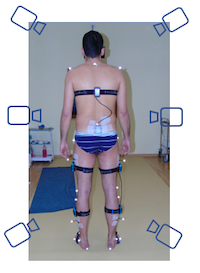
At the Gait&Motion Analysis Laboratory of the Sol et Salus Hospital in Rimini, Italy, we tested a commercial Multi-IMUs system produced by TecnoBody, an Italian leader in medical and rehabilitation sector. This tool can be easily worn through belts, saving a lot of preparation time and is capable of providing joint angles.
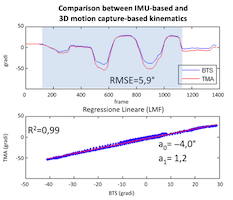
In order for this system to be put on the market, we carried out a validation study comparing the data obtained by 3D motion capture (gold standard) with those provided by IMUs. The results showed a large degree of overlapping, confirming the validity of the new system in correctly recording the values, as can be observed from the R² value of the linear regression we calculated.
As we have already extensively illustrated in a study carried out at the Motion Analysis Laboratory of Correggio (Azienda USL-IRCCS of Reggio Emilia), an incorrect or rough positioning of wearable sensors (in that case electrodes for surface EMG) can determine unreliable signals, with EMG traces that do not correspond to the real functionality of the muscle analysed.
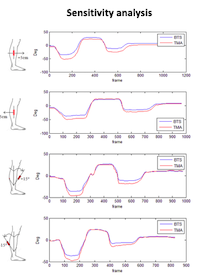
We verified if the same phenomenon occurred in the case of IMUs, by means of a sensitivity analysis, where a set of know sensor misplacements were performed and the amount of error in joint kinematics was measured. The results showed that little deviations from the vertical alignment are permissible.
The device was brought onto the market, contributing to accurate yet time-saving motion assessments.