The studies on the kinematic analysis of chewing cycles – already mentioned in a previous editorial – conducted during the Ph.D. of Andrea Merlo, founder of MerloBioEngineering, have found their application in several papers published during those years.
The normative values of chewing cycles
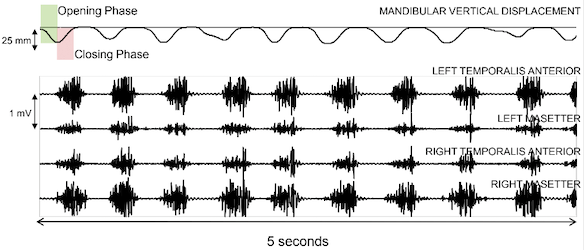
Together with the team of Dr. Maria Grazia Piancino from the Dental School of the University of Turin, a first study was conducted to analyse the different activation of the main masticatory muscles and the masticatory pattern, according to the type of bolus presented. Twelve healthy children performed the examination first with chewing gum (soft bolus), then with wine gum (hard bolus), wearing the Myotronics K7 evaluation system for kinematic data collection and electrodes on the masseter and anterior temporal muscles for the electromyography.
Using a custom–made software developed by engineer Merlo during his PhD, data were selected and analysed according to criteria established a priori for the use of the tool, which allowed a clear data computation in favour of variability, compared to previous methods by Lewin, Buschang and Shiga.
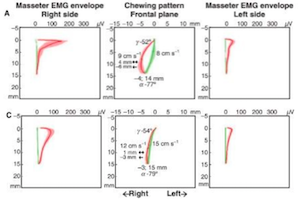
It was found that the pattern became higher and wider when chewing a harder bolus, reducing the closure angle and increasing the peak velocity.
The full-text article can be found here. Thanks to the results obtained, the study was able to provide initial normative reference values, which were then used for subsequent work to evaluate impaired chewing conditions.
A comparison with subjects with unilateral posterior crossbite
Indeed, immediately in the following year, the working group conducted a comparative study on twelve healthy subjects versus 82 children with a unilateral posterior crossbite, a malocclusion present in developmental age that must be promptly corrected to avoid structural alterations of the jaw and that leads to altered chewing patterns.
Using the same protocol as the previous work, kinematic and electromyographic values were recorded and subsequently analysed with the customised software. The reverse cycles, characteristic of crossbite, showed some altered parameters compared to controls, while at the EMG study the masseter of the unaffected side had greater activation than that ipsilateral to the crossbite.